
Ellis Projected Versus Actual Release
A projected date is a current calculation. It may account for the sentence, credit already entered, and the rules attached to that case. An actual release date records a completed departure from custody. KASPER uses the exact label Earliest Possible Release Date. That wording does not promise a gate event, and it does not show that all other holds have cleared.
A pretrial detainee has not yet received a final jail or prison sentence. Release may turn on bond, recognizance, dismissal, a court order, or pickup by another authority. Ellis County publishes no formula that converts a pending county charge into a release date. The sheriff's current Alpha Prisoner Listing also has no projected or actual release field.
Find an Ellis Inmate Release Date
First identify who holds the person. Ellis County Jail, KDOC, another county, a federal agency, and ICE keep separate records. A result from one cannot establish the status in another. Use the current Ellis jail-log route only to check the roster snapshot, not to calculate release.
- For a person in Ellis County Jail, ask whether the case is pending or sentenced. Check the correct court for the order and ask the jail for any existing custody-time or release entry.
- For a Kansas prison sentence, enter KASPER and match the person with several identifiers.
- Read “Earliest Possible Release Date” exactly. Also note current location, status, and any supervision information.
- For an older indeterminate sentence, check the Prisoner Review Board process. Eligibility or a hearing is not release.
- Confirm a completed event through the jail, KDOC record, or receiving agency. Use the VINELink Release Check for Ellis county-jail alerts.
KASPER permits searches by first, middle, and last name, aliases, KDOC or KBI number, date of birth or age range, race, sex, county of conviction, and parole-supervision county. Use the most specific lawful combination available. A common name alone is weak evidence. KASPER updates on working days, so a recent event may not appear at once.
Ellis Release Date Sources
The correct record depends on the sentence and custodian. A county-court order can explain the legal basis for a change, while the jail record establishes the physical departure. State-prison calculations belong to KDOC. Keeping those jobs separate avoids the common error of applying a prison credit rule to an unsentenced jail stay.
| Custody or case | Best date source | Key limit |
|---|---|---|
| Ellis pretrial custody | Jail and the correct district or municipal court | No fixed date may exist. |
| Ellis county-jail sentence | Sentencing order and jail custody record | No local public calculator was found. |
| Kansas state prison | KASPER and KDOC records | Earliest possible is not actual. |
| Older indeterminate sentence | KASPER, sentence law, and Prisoner Review Board | Eligibility and review do not guarantee release. |
| Federal custody | Federal BOP locator | A BOP date proves only federal custody status. |
Municipal arrestees can be held in Ellis County Jail while the case remains in municipal court. Hays Police matters may require the Hays Municipal Court channel, while sheriff and Kansas Highway Patrol cases use county channels. Searching only the statewide district portal can therefore omit the order relevant to a Hays municipal case.
Kansas Good-Time Release Rules
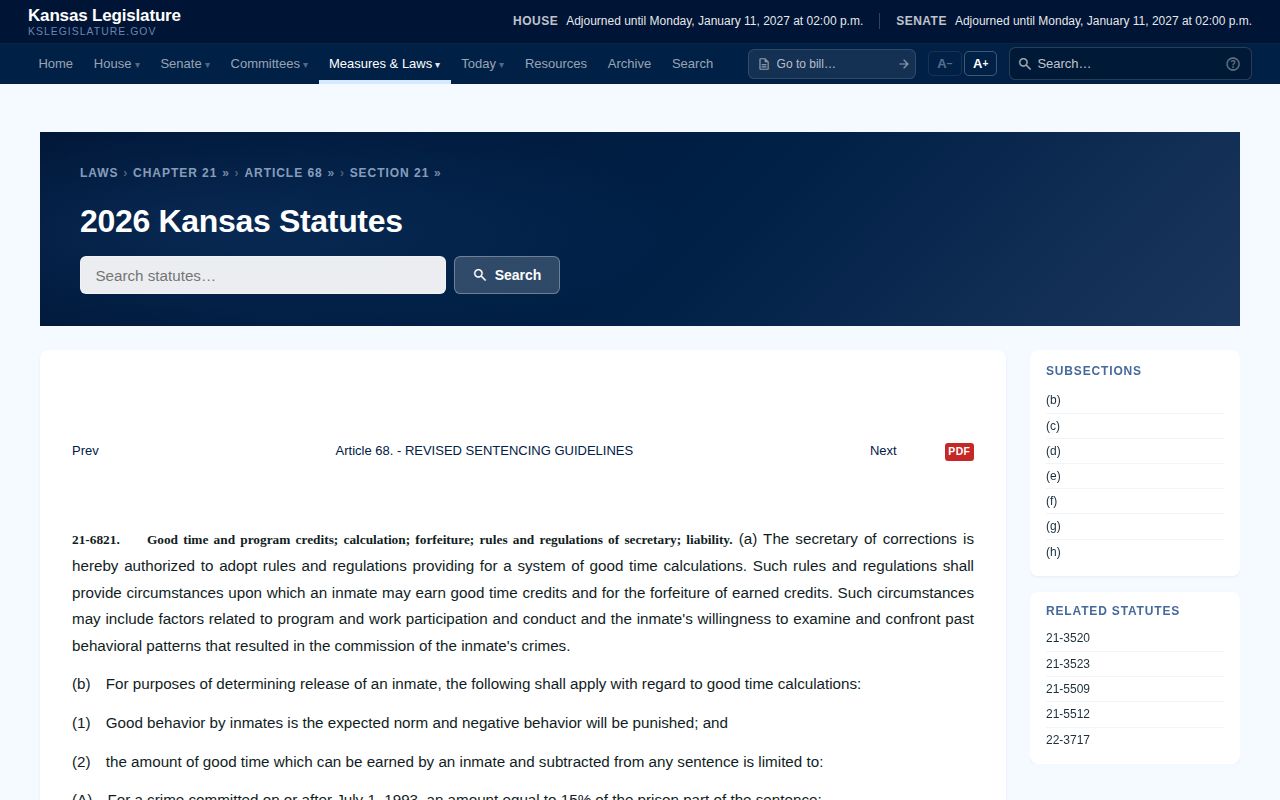
K.S.A. 21-6821 governs good-time and program credits for covered modern sentences. Good time is credit that can reduce the time served when the person is eligible and the credit is awarded and retained. For most covered modern cases, the statute sets a maximum good-time ceiling of 15 percent. This is the source of the rough 85-percent shorthand, but that shorthand is not a universal Kansas rule.
Specified lower-severity and drug categories can receive a 20-percent ceiling. Eligible people may also receive up to 120 days of program credit. The statute and offense category must be checked before doing any estimate. Credit is not merely subtracted from a number found in news coverage. Consecutive cases, jail credit, the postrelease portion, court amendments, and the actual credit record can all affect the calculation.
Older indeterminate sentences operate under a different framework. K.S.A. 22-3725 addresses credits for applicable indeterminate sentences, while K.S.A. 22-3717 addresses parole eligibility and postrelease. Determine the sentencing framework before applying a percentage or a parole-hearing model.
The official Kansas good-time statute shows why an Ellis County release estimate needs offense-specific review.
Is Kansas Always 85 Percent?
No. This Ellis County release-date question deserves its own answer because the common shortcut can materially misstate the record. The 15-percent ceiling can produce an approximate 85-percent floor for an eligible covered sentence only when credit is earned and kept. The 20-percent category and program-credit provision show why Kansas is not uniformly an “85-percent state.”
Use the KASPER field rather than publishing a hand calculation as fact. Then verify which statute applies to the offense date and sentence. “Earliest possible” means the earliest date under the calculation shown at that time. It can move if the inputs change, and a detainer can still redirect the person into another authority's custody.
Why Ellis Release Dates Change
A projected date changes when the underlying legal or correctional inputs change. Some events move the estimate. Others mean the date no longer answers the reader's real question. A court amendment can alter the sentence itself, while a receiving-agency hold changes where the person goes after one custodian releases them.
| Factor | Effect on the date or outcome |
|---|---|
| Good-time award or loss | Changes credit applied under the governing rules. |
| Program credit | May reduce time for an eligible person within the statutory limit. |
| Consecutive case or amended order | Changes the controlling sentence calculation. |
| Jail-time credit | May alter credit for time already held when legally applied. |
| Detainer or other hold | May cause transfer rather than community release. |
| Parole action | May affect an eligible indeterminate case, but review is not the gate event. |
A detainer is a request or basis for another authority to take custody. Ellis County's sheriff FAQ states that a person held for another county or state remains until pickup. A name can thus disappear from Ellis custody and appear in another system without a community release.
Ellis Parole Dates Are Milestones
Parole applies mainly to an eligible indeterminate framework and means conditional release from prison under KDOC supervision. Postrelease is a period of supervision that follows many determinate sentences. Neither term means final discharge. The Kansas Prisoner Review Board process should therefore be read as a sequence rather than a promised release date.
A person listed for public comment or scheduled for a hearing is in the review pipeline. That listing proves neither a favorable decision nor a later gate event. After the review, check for the later KASPER status and the agency's actual release record. If the person enters parole or postrelease status, they may be out of prison while still subject to KDOC supervision. Final discharge requires the later discharge evidence.
The safest phrases are “earliest possible,” “eligible for consideration,” and “scheduled for hearing.” Use “released” only when the controlling custody record reports an actual departure. This vocabulary prevents an Ellis County family or support person from planning around a date that is still conditional.
Confirm the Ellis Actual Release
After the projected date passes, look for the completed event. In KASPER, a parole or postrelease status can mean the person has left prison but remains under KDOC community supervision. “Current Status Discharged” and “Date Discharged” indicate that the KDOC status represented by that record has ended. Discharge is not the same milestone as leaving the prison gate.
For an exact KDOC date, request an existing release summary or movement chronology through the KDOC GovQA records portal. Distinguish actual prison release from maximum-sentence discharge. For Ellis County Jail, ask the sheriff for the actual release date and time, disposition, and receiving agency if transferred. The broader Ellis County released inmate search provides the court and records-request sequence.
When two official systems seem inconsistent, build a timeline with the source, timestamp, agency, and exact label. Prefer the agency that controlled each interval. A KASPER working-day lag, a jail PDF print time, or a later receiving-agency admission can explain an apparent conflict. Ask the earlier custodian for its receiving-agency field and the later custodian for its admission event.
State only what the final record proves. A projected date is a calculation. A court order is legal context. A recorded release or movement entry is the custody event. That separation is the soundest answer to when an Ellis County inmate will be released.