
Parole vs Probation in Ellis County
These terms should not be used as synonyms. Kansas Department of Corrections Parole Services supervises parole, conditional release, and postrelease cases. The 23rd Judicial District Court Services office handles local probation and bond supervision, while Northwest Kansas Community Corrections handles intensive supervision. The controlling record depends on which path the court or KDOC assigned.
| Supervision type | How it begins | Primary verification source |
|---|---|---|
| Parole | Community supervision under the older discretionary release framework | KASPER status, KDOC Parole Services, and the Kansas Prisoner Review Board record |
| Postrelease supervision | Community supervision after the prison part of a modern determinate sentence | KASPER and KDOC Parole Services |
| Court probation | A district or municipal court orders community supervision | The judgment, register of actions, and Court Services |
| Community corrections | A court places the person on intensive supervision | Court record and Northwest Kansas Community Corrections |
| Bond supervision | The court releases a defendant while the case remains open | Filed bond order and 23rd Judicial District Court Services |
How to Verify Ellis County Post-Release Supervision
Begin with the source that can distinguish state supervision from a local court case. Use more than a name when possible because aliases, common names, and stale status fields can produce the wrong conclusion.
- Search KASPER for a KDOC number or a careful name-and-birth-date match. Read the exact Current Status, location, and supervision fields.
- If KASPER shows parole or postrelease, use the KDOC parole contacts to identify the office and confirm current supervision.
- For probation, bond supervision, or community corrections, search the Kansas district case and read the filed judgment or latest register entry.
- Confirm ordinary probation with 23rd Judicial District Court Services and intensive supervision with Northwest Kansas Community Corrections.
- If absconding is a concern, check the separate parole and community-corrections absconder pages, then verify any later custody event with the relevant office.
- For proof that supervision ended, request the successful-discharge order, agency disposition, or KASPER discharge record rather than relying on a missing search result.
KASPER updates on working days, not continuously. It also cannot display community-corrections probation events after April 21, 2021 because of a stated data-modernization gap. Direct confirmation is essential for recent Ellis County community-corrections activity.
Ellis County Supervision Offices in Hays
Two local offices serve different roles. The similar names and differing address entries are a reason to identify the case type before visiting. KDOC's directory lists Northwest Kansas Community Corrections at one address, while the local court directory lists another. The shared telephone number is the safest way to confirm the current reporting site.
23rd Judicial District Court Services
Scope: probation, bond supervision, and work release
107 West 12th Street, Hays, KS 67601
785-628-9419
Northwest Kansas Community Corrections
Scope: intensive community supervision
Local court listing: 117 East 13th Street, Hays
KDOC directory listing: 1011 Fort Street, Hays
785-625-9192
KDOC also lists an Automated Reporting System at 866-570-7225. It is a supervision resource, not a public historical lookup or a substitute for identifying the office that owns the case.
Ellis County Absconder and Warrant Checks
KDOC publishes separate KASPER pages for parole absconders and community-corrections absconders. The distinction matters. A parole entry concerns KDOC supervision, while a community-corrections entry concerns a court-based intensive program. K.S.A. 75-5217 describes absconding as knowingly avoiding supervision and making one's whereabouts unknown, and it permits a warrant.
The official KASPER parole-absconder page shows the separate state lookup used for this narrow status.
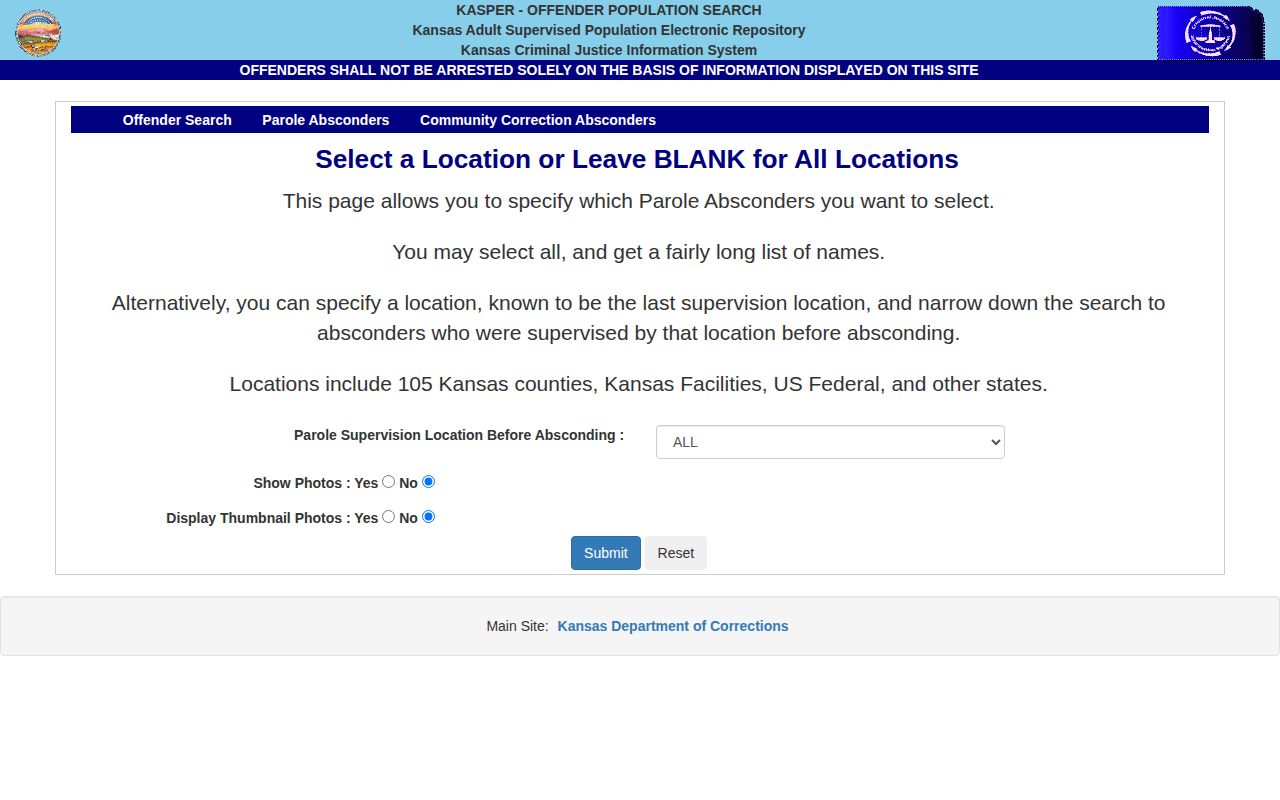
This screen should be followed by current custody and agency confirmation because a listing alone does not locate the person.
After a match, check the current Ellis County Jail list, KASPER custody, and the supervising office. Kansas VINE can report a later county-jail custody event for one registered person, but Kansas VINE does not cover KDOC prison offenders. Conditions and alleged violations should be verified from filed orders and the agency record, not inferred from a custody change.
How Ellis County Supervision Ends
Supervision ends through the process that created it. A court can record successful completion or discharge from probation. KDOC can record discharge from parole or postrelease. A revocation, warrant, new order, or transfer does not equal successful completion even if the person disappears from a public list.
For a KDOC case, read Current Status and Date Discharged in KASPER, then ask KDOC for a durable record if exact proof matters. For probation or community corrections, use the court register and request the supervising agency's completion disposition. KASPER silence is especially weak for recent community-corrections events because of its documented data gap. The broader Ellis County released-inmate search path explains how to reconcile jail, court, VINE, and state records when custody and supervision appear to conflict.
Ellis County's Local Supervision Landscape
Ellis County has three meaningful community routes beyond KDOC's state framework. Court Services handles probation, bond supervision, and work release. Northwest Kansas Community Corrections provides intensive supervision. Recovery Court is a separate structured court program. These routes can all place a person in the community without showing that the case or supervision has ended.
The official Recovery Court page says the program was formed in 2018, uses five phases, lasts at least 15 months, and meets every other Thursday. Intensive supervision is supplied through Northwest Kansas Community Corrections. Participation therefore explains a form of community status, but it is not an Ellis County release date, a successful-discharge record, or proof that every obligation is complete.
Use the judgment and current court entries to distinguish these local routes. A person may move from jail into bond supervision, receive probation as a disposition, or enter intensive programming after a court order. None of those should be relabeled parole. Likewise, a parole or postrelease status in KASPER should not be sent automatically to local Court Services. The source that created the supervision remains the best source for current terms and final discharge.
Conditions also come from that source. A filed probation order is the best public context for court supervision, while KDOC sets and administers conditions for its parole and postrelease population. General descriptions cannot establish the duties in one person's case. When a current answer matters, use the supervising office and the latest order or agency record. A VINE custody alert does not describe supervision conditions, and the current Ellis County jail snapshot does not show them.
Jurisdiction matters even within Hays. A municipal case and an Ellis County District Court case can use different court channels. The fact that Ellis County Jail housed a person does not prove which court imposed supervision. Start with the charging agency and case number, then locate the judgment. This reduces the risk of asking Court Services about a KDOC case or asking KDOC about a municipal probation file.
When records appear to conflict, build a short timeline. Note the source, the date of its update, the exact status words, and the agency controlling that interval. KASPER may show postrelease while a court docket shows probation in a different case. Both can be accurate. An absconder entry may predate a later arrest. Ask the agency that created the disputed field to confirm or correct it rather than asking another office to reinterpret it.
A discharge record deserves the same care. Current Status Discharged and Date Discharged in a KDOC record refer to the KDOC matter represented there. They do not certify that every local case, warrant, or court obligation has ended. A successful probation discharge applies to the court case identified in the order. State conclusions at that narrow scope and preserve the case or offender identifier used for the match.
Notification systems do not replace this review. Kansas VINE covers adult county-jail custody and can alert a registered user to release, transfer, or escape. It expressly does not include KDOC prison offenders. KDOC Victim Services has a separate notification process for eligible people tracking KDOC custody or supervision. Neither service is a public history of all Ellis County probation events.
When a formal record is needed, ask the office that owns it for the existing disposition. For KDOC, that may be a release summary, supervision status, or discharge entry. For court probation, request the filed order or register entry. Give the name, case or offender number, and a bounded date range. A precise request reduces same-name errors and avoids asking staff to create a narrative that does not exist.
Privacy and record limits still apply. Sealed, expunged, juvenile, personally sensitive, and court-restricted material may not be public. A public lookup is not a certified statement, and an office may need identity details before discussing a current case. If information is withheld, ask which record can be released and what official process applies. Do not treat a limited response as evidence that supervision never existed.
The sound final answer names the type, agency, and date verified. For example, distinguish current KDOC postrelease supervision from active court probation, and distinguish either from a recorded discharge. This makes the conclusion useful without extending it beyond the official source.